
Your work tells tales. It speaks about you, your values, your hopes, your ambitions, and what you believe is worthy of your energy and attention. Whether you intend it or not, it reveals what you really think about the world around you. So here is a question worth sitting with for a moment. Your work certainly speaks about you, but does it speak for you? Does it sound like you, or does it sound like everyone around you?
Many people operate in default mode. They ignore their hunches and their deeper intuition, and they settle into the fold. Over time their work becomes a reflection of everyone else’s, a faded photocopy of a photocopy, instead of an original source of ideas and energy and life. Brilliant contributors take a different path. They commit to the slow, sometimes painful process of developing an authentic voice, through trial and error, through paying attention to how they respond to the work of their peers and heroes and even their antagonists, and through honing their skills until they can bring their vision into the world.
That process is the subject of Louder Than Words. Whether you are a writer, a manager, an engineer, an entrepreneur, or an artist, I believe the most important work you will ever do is the work necessary to develop an authentic voice. What follows is a walk through the core ideas of the book, and the practices that can help you find the voice that only you can bring.
What voice isYour occupation is a platform. Your voice is the point.
When I talk about voice, I mean the expression you make through a medium in order to achieve an impact. An idea, a platform, and an outcome. And when I say authentic, I don’t mean total transparency. I mean a voice that is sourced in the interplay of your unique passions, skills, and experiences. Your authentic voice is your most genuine response to your environment. It defines the space you alone are capable of occupying, which means that if you don’t use it, that contribution is unlikely ever to be seen.
It helps to draw a sharp distinction between your occupation and your vocation. Your occupation is how you make a living. It’s a platform, the arena where you’re given a chance to make an impact. Your vocation is the unique expression you make through that platform. Many people spend most of their energy trying to grow their platform and very little developing their voice. They may grow the awareness of their work for a while, but their impact stalls, because it isn’t rooted in anything substantive. Your voice is the fuel that sustains your pace.
The Voice EngineThree questions power every resonant voice.
A compelling, authentic voice is the expression of identity, guided by vision, and achieved through mastery. Each one answers a simple question. Identity asks, “Who are you?” Vision asks, “Where are you going?” Mastery asks, “How will you get there?” Your sense of identity leads to a compelling vision, which illuminates the skills and platform you need to master. When one of the three is missing, the whole engine sputters.
The Voice Engine
Miss one piece, and the work falls flat.
Most of us are strong in one or two of these and quietly neglect the third.
Identity, vision, and mastery together make a voice compelling.
Your weakest link
Which question is hardest for you to answer?
Everyone needs growth in all three. Naming the weakest one tells you where to focus first.
Choose one, and keep it in mind as you read on.
The hurdlesStruggle isn’t a sign you’re in the wrong place.
Many people hit difficulty on the way to finding their voice and misread it as a sign that they’re on the wrong path. They assume that if they were truly meant to do this work, everything would fall into place. That belief stops a great many people short of the work that could have defined them. There are three hurdles in particular that you will have to clear again and again.
The first is paralysis due to fear. Most of us remember the monster that lived in the closet or under the bed when we were children. I remember lying frozen at night, refusing to get out of bed for even the most urgent of reasons. As adults our monsters are more sophisticated, but they work the same way. They are usually the stories we tell ourselves about what might happen if we step out, and they keep us in bed long past daybreak.
The second is false or limiting narratives, beliefs that somehow became embedded, then fossilized into assumptions, and now quietly limit what you believe is possible for you. The third is inertia. For years my commute was twenty minutes by car, and I would often pull into the parking lot shocked that I had already arrived, because I’d driven the entire way on autopilot. Many of us have set our work to cruise control in exactly the same way. We’re moving, but we stopped choosing the route a long time ago.
The aspiration gapYour taste is ahead of your ability.
The radio host Ira Glass once described a frustration nearly every creative person knows. When you start out, your taste is good enough to recognize that your work isn’t yet as good as you want it to be. That distance between the work you want to make and the work you are capable of making right now is what I call the aspiration gap. Closing it is the primary job of anyone who creates, and the only way through is to keep making work, a lot of it, and endure a season of disappointment long enough to grow.
We often hear stories of people who jumped into the deep end and figured it out, but you would never teach your child to swim that way. The most resonant voices are developed over time through observation, practice, trial, error, and eventual success. Even the masters keep returning to the basics. As you develop your voice, you will move through four phases, and you will move through them more than once.
The four phases of growth
Growth isn’t a straight line. It’s a curve you climb again and again.
Knowing which phase you’re in makes the struggle easier to interpret, and easier to endure.
- 01 · DiscoverySomething reawakens a desire to create, and you take your first eager, clumsy steps.
- 02 · EmulationYou build the fundamentals of your craft by learning from those who have already mastered it.
- 03 · DivergenceYou decide whether to stay in your lane or take small, public risks into new territory.
- 04 · CrisisYour work grows stale, even if no one else notices, and you have to choose growth over comfort again.
The crisis phase is the most dangerous, precisely because it can be invisible. Your friends may tell you the work is great, and it may still stand with the best in your field. Deep down, though, you know you’ve stopped growing and settled into a pattern of safety. That’s the moment to go back to the beginning of the curve.
IdentityWho are you, really?
When I talked with Jocelyn Glei, who led the creative think tank 99U for years, she told me that publishing had always been the through-line of her work, but that it only became clear looking backward. Your through-line is the central theme that runs through your best moments, and it isn’t something you invent. It’s something you uncover by paying attention to where you come alive and where your work resonates most deeply with others.
One practice I often prescribe for this is called the 50 Notables. It uses five questions to help you see the patterns in your own life. Take a few minutes with each one and try to list ten specific instances. Then look across the whole list for the themes that keep showing up.
The 50 Notables
Five questions, ten answers each.
Check each one off as you finish your list.
Once you can see those patterns, write them down as a manifesto, a short living creed that captures who you are, what you stand for, and where you’re headed. A man I’ll call Don once sat across from me over coffee, unsure of his next step after learning his job was ending. I asked him to write his manifesto, and a month later he sent me a draft. I told him it was too vague, and that I didn’t believe him yet. When he came back with his next version, the cloudiness was gone, his language was active, and he seemed to have a newfound sense of where he was going.
If you are not a little intimidated by your own manifesto, it’s unlikely that anyone else will be moved by it either.
Your uniqueness also shows up in how others respond to you. A real estate agent I interviewed surveyed the people he had worked with, and three words kept coming back: calm, comfortable, and empowered. Those became the pillars of his business, and they gave him the confidence to say no to work that didn’t fit. You discover what makes you unique not by thinking alone, but by thinking through action and paying attention to the patterns.
VisionYour voice is for someone.
Looking inward is only the beginning. For your voice to resonate, your vision has to center on the people you’re trying to reach. That requires two things: a precise picture of whom you’re serving, and genuine empathy for what they need. Remember that your work is not about you. It’s about the impact you create and the value you deliver to those you serve. You are not creating your work for critics.
Impact begins with empathy, and the most effective voices make their audience the hero of the story. They also learn to evoke rather than provoke. When I was a child, the playground bully would draw a line in the mulch with his foot and dare someone to cross it. Plenty of work is made that way today, built to provoke a reaction and draw a crowd. Provocation gets attention, but it rarely changes anyone. Evocation draws people toward something they already sense is true, and that’s where lasting impact comes from.
MasteryBe ready when the moment comes.
In 2013, during a Q&A session at Vanderbilt University, a student stepped up to the microphone and asked Billy Joel if he could accompany him on piano. Joel asked which key he wanted to play in, and the student answered, “Any key you want.” What followed was an astonishing performance that went around the world. It looked like a lucky break, but it was really the moment when years of preparation met a few seconds of opportunity.
That’s why I keep a short list of practices I call dailies, a set of rituals tied to the long-term goals in my life and work. I keep them on a small card in my notebook and check them off each day, then look back at the end of the month to see whether I’m behaving like the person I want to become. Mine include reading for an hour, writing a thousand words, reviewing my biggest open creative problems, walking, having a meaningful conversation with my wife and each of my kids, and taking time to pray and let my mind wander. Yours will look different, but the principle is the same. Slow and steady alone doesn’t win the race. Slow, steady, and deliberate wins, punctuated by occasional sprints.
It also helps to understand the three responsibilities you carry in your work. You have a responsibility to your stakeholders, the clients and colleagues and family members depending on you to deliver. You have a responsibility to yourself, to follow your intuition and bring your unique perspective. And you have a responsibility to the work itself, to ask what the idea wants to become and give it room to become it. Most of the times we get stuck trace back to the tension among these three. Choose the one you struggle with most, and commit to one small daily act that strengthens it.
Up the curveSomething good has to die so something great can be born.
In hundreds of interviews with brilliant contributors, one word comes up over and over when I ask how they developed their unique style: patience. In the rush toward recognition, it’s tempting to latch onto an early win and squeeze it for everything it’s worth, until you become a caricature of yourself. We accept without question that leaves fall and flowers fade so that new life can come. We rarely give ourselves permission to let our own work follow the same rhythm. Yet you become stagnant when you refuse to let go of what once worked.
Your voice is also more of a movie than a photograph. On any given day, you may not feel like you’re making progress. It’s only when you look at the whole arc that you see how far you’ve come. And in the end, your voice is a gift. The author Lewis Hyde argues that a creative gift is meant to be given away, and that in being given it eventually returns to the giver. A gift given away in freedom has a vast impact. A gift spent on the giver quickly fades.
Your work will always tell tales about you. The question is whether you will do the work necessary to make sure those tales are true, so that what you make sounds like you, serves the people it’s meant for, and adds something to the world that no one else could have added.
Your work will always speak about you. Make sure it speaks for you.
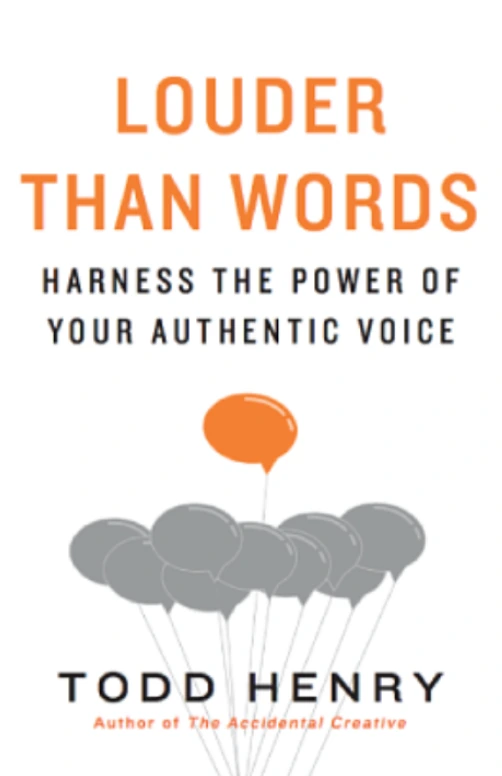
Go deeper with Louder Than Words. Every idea here is unpacked in the book, with the full 50 Notables exercise, a guide to writing your manifesto, and practices for developing your team’s voice. Explore the book.
Bring these ideas to your team. The Infinite Lever is a keynote about the human contributions AI can’t replace, starting with a voice that is unmistakably yours.
Explore the keynote
Todd Henry
Todd teaches leaders and teams how to be brave, focused, and brilliant. He’s the author of seven books, including Herding Tigers and The Brave Habit, and host of the Daily Creative podcast.