
A friend once asked a small group of us a question that changed the way I work. “What,” he asked, quoting the late Myles Munroe, “is the most valuable land in the world?” We offered the guesses you would expect, the oil fields and gold mines and the priciest blocks of Manhattan, and one by one he told us we were wrong. The most valuable land in the world, he said, is the graveyard. Buried there are the books that were never written, the businesses that were never started, the relationships that were never mended, and the ideas that never made it out of someone’s head. All of them were saved for someday, and for every one of those people, someday ran out.
I went home that night and wrote two words on a piece of paper: Die empty. They became a reminder, and eventually a book, about refusing to take my best work to the grave with me. Over the years I’ve watched brilliant, capable people quietly settle into lives that look fine from the outside while the work they care about most sits on a shelf marked “later.” The problem is almost never a lack of talent. It’s the stubborn belief that we will always have tomorrow.
To die empty doesn’t mean exhausting yourself every day, or grinding until there’s nothing left. It means putting your best work into the world while you still can, and building a life that reflects what you value, so that when your days run out you aren’t carrying that work with you. The goal is to finish free of regret and full of satisfaction for how you spent your time. What follows is a walk through the core ideas of Die Empty. Take it slowly, and pay attention to the one or two ideas that sting a little. Those are usually the ones meant for you.
Your contributionYour work is bigger than your job.
When most people hear the word “work,” they think of their job. I define it much more broadly. Your work is any place in your life where you add value that didn’t exist before. That certainly includes what you do for a paycheck, but it also includes how you show up in your marriage and your friendships, how you raise your kids, what you give to your community and your church, the people you mentor, and the things you make simply because you believe they should exist. Some of the most important work you will ever do won’t appear on a résumé.
Seen that way, every day you’re adding to a body of work, whether you intend to or not, and at the end of your life it will stand as evidence of what you believed and what you cared about. The question isn’t whether you’ll leave one behind. It’s whether the one you leave will actually reflect you. To build it, you spend four limited resources every day: your focus, your assets, your time, and your energy. You can’t make more of any of them, so the only real question is where they go. When someone tells me they feel stuck, the cause is almost always hiding in one of those four.
Across every arena of life, that work comes in three forms. Most of us are good at one or two of them and quietly neglect the other, and that neglect is where many people begin to stall.
Mapping, Making, and Meshing
The work, the work before the work, and the work between.
You need all three, in your career and everywhere else you add value, and you need to engage each one on purpose rather than by accident.
Mapping
Planning, setting objectives, and deciding priorities. It’s the work before the work that makes sure your focus, time, and energy land in the right places.
Making
Doing the work and following through on the plan. It’s where value actually gets created, at a desk, at the dinner table, or in a neighbor’s driveway.
Meshing
The work between the work: growing your skills, sharpening your thinking, and investing in yourself. It’s the hardest to justify and the most important over time.
Meshing is the one most people sacrifice first, because nobody applauds it. You won’t get praised in a meeting for reading a difficult book, and no one at home will thank you for the hour you spent learning how to listen better. Yet meshing is what keeps you from waking up one day to discover that the world has moved on and you haven’t.
How you balance these three tends to place you in one of four profiles. The Driver maps and makes but never meshes, so he gets results today while slowly becoming obsolete for tomorrow, and he often misses opportunities outside his immediate focus. The Dreamer maps and meshes but rarely makes, so she’s full of plans and fascinating ideas that never quite become real. The Drifter makes and meshes without mapping, working hard and learning constantly while bouncing from one shiny project to the next, so very little crosses the finish line. The Developer does all three. She plans the work, does the work, and keeps investing in the skills the next season will require, and over time her body of work compounds. Most of us move between these profiles over a lifetime. The goal is to recognize where you are now, and to move deliberately toward the fourth.
Your profile
Look at your last month.
Not your best month, and not the month you plan to have. Which profile describes how you actually spent your days?
Choose one. Then make whatever change you need to make today to move one step closer to Developer.
The siren songMediocrity never arrives all at once.
Nobody wakes up one morning and decides to become mediocre. It happens slowly, through a series of small choices that each seem perfectly reasonable in the moment. You skip the hard conversation because things are almost settled. You say yes to the familiar assignment because it’s safe. You let a question go unasked because you’re busy. None of these choices is a disaster on its own, and that’s exactly what makes them dangerous. Each one makes the next a little easier, until one day mediocrity simply feels normal and you stop noticing the work you’re no longer doing.
In my work with creative professionals and leaders, I’ve found that this slide almost always runs through one of seven traps. I call them the seven deadly sins of mediocrity, and they conveniently run from A to G.
The seven deadly sins of mediocrity
Seven quiet traps, and the way out of each.
Most of us can see ourselves in two or three. You don’t need to fix all seven. Start with the one that’s costing you the most.
- A · AimlessnessWorking hard without direction. The way out: define your battles.
- B · BoredomBusy, but no longer stretched. The way out: be fiercely curious.
- C · ComfortProtecting what you’re known for. The way out: stay out of your comfort zone.
- D · DelusionChasing someone else’s idea of success. The way out: know yourself.
- E · EgoGuarding your image instead of serving the work. The way out: be confidently adaptable.
- F · FearLetting the risk of failure decide for you. The way out: find your voice.
- G · GuardednessClosing yourself off when you most need others. The way out: stay connected.
Define your battles.
You can’t win a battle you haven’t defined. Aimlessness rarely looks like laziness. More often it looks like a full calendar, a crowded inbox, and a vague sense at the end of the day that none of it added up to much. The antidote is what I call productive passion, and it’s different from the kind of passion people usually talk about. Productive passion isn’t about what you enjoy. It’s about what you’re willing to suffer for, and it often shows up as compassionate anger, the sense that something in the world is broken and you can’t simply stand by and watch. So instead of asking what would make you happy today, ask what you’re willing to suffer for.
Once you know what you’re fighting for, look for your forgotten fronts, the important efforts that slipped quietly off your radar while you were busy, and your open loops, the commitments you made and never closed. Each one drains a little energy every day it stays open. Then write a single sentence that names the value you want to create and for whom, and read it once a month. It will tell you very quickly when you’ve started to drift.
Be fiercely curious.
Boredom today rarely looks like sitting around with nothing to do. It looks like constant activity with no real stimulation, a condition I call being busily bored. You answer messages, attend meetings, and move from one obligation to the next, and somewhere along the way you stop asking the questions that once made life interesting. Curiosity is a muscle, and if you don’t exercise it deliberately, the always-on world will happily exercise it for you, one distraction at a time.
Start by listing the questions you should be asking but aren’t. Then make a list of the twenty things you most want to read, watch, or explore over the next year, and actually work through it. Most importantly, find your bliss station, a consistent time and place where you follow your curiosity without an agenda. It doesn’t need to be long. It needs to be protected.
Stay out of your comfort zone.
Comfort can be the result of good work, but it can never be the goal of it. The moment you become known for something, there’s a strong pull to stop growing and start protecting. One simple test reveals a lot. Ask yourself what you would change about your work. If your answer begins with what someone else would need to do first, that’s a contingency response. If it begins with what you will do, that’s an ownership response, and ownership is where growth starts.
Choose two or three areas where you most want to grow, and for each one set three kinds of goals: a step you can take this week, a sprint that builds real capability over the next few months, and a stretch that is beyond your reach today and pulls you toward who you want to become. A good place to begin is a skill that mildly intimidates you but would make everything else easier if you had it. That small knot of discomfort is usually pointing directly at your next season of growth.
Know yourself.
Delusion is subtle, because it rarely feels like self-deception. It feels like ambition. You chase the title, the role, or the kind of life that someone else defined for you, and you never stop to ask whether it fits the way you’re actually wired. Often what’s steering you is a set of ghost rules, invisible narratives about what success is supposed to look like that you absorbed from a parent, a former boss, or a culture, and that still shape your choices whether or not you notice them.
You can’t make your unique contribution while you’re busy pretending to be someone else.
Two practices help here. First, name your superheroes, the people whose lives and work you admire, and ask what about them intimidates you, what resonates with you, and what connects with the problems you care about. Your answers will tell you more about yourself than about them. Second, define your four-word ethic, four words that describe how you want to engage your work every day. Write them where you’ll see them, and use them as a filter when you’re deciding what to say yes to.
Be confidently adaptable.
Ego and confidence can look alike from a distance, but they behave very differently when circumstances change. Ego is preoccupied with protecting itself. It needs to be right, it hears feedback as an attack, and it quietly holds back when it feels overlooked. Confidence is secure enough to adapt. It cares more about getting it right than being right, it hears feedback as information, and it gives its best whether or not anyone notices.
Pay attention to where you feel a strong need to control things, and where you might be playing the victim because your contribution isn’t being recognized the way you think it should be. Then try a simple antidote. Spend ten minutes writing an encouraging, entirely selfless note to someone else. It’s very difficult to protect your ego and celebrate someone else at the same time.
Find your voice.
Fear is the most familiar of the seven, and it usually wins by making the safe choice look responsible. When the consequences of failure feel larger than the rewards of success, you settle, and you tell yourself it was the prudent thing to do. The way out isn’t to eliminate fear. It’s to pay closer attention to your voice, the unique perspective you bring to the world, and to let it become louder than the fear.
Your voice is often hiding in plain sight. Look back over your life for the moments when you felt most fully yourself and most useful to others, list the ten times you were most clearly in your sweet spot, and look for what they have in common. Then ask what is obvious to you that isn’t obvious to the people around you.
What feels obvious to you is often the very thing others can’t see.
Once you’ve spotted it, take one small, strategic risk this week, something that could fail but could also move your work forward. Your voice doesn’t emerge in one bold leap. It emerges through a series of small acts of courage.
Stay connected.
The more your responsibility and reputation grow, the more tempting it becomes to retreat. Busyness isolates you, and success can make vulnerability feel risky, so you share less, ask for less help, and avoid the conversations that might expose a weakness. This is exactly backward, because the further you go, the more you need people who will tell you the truth.
Find someone who can act as a mirror, a person who will reflect back to you what they see, both good and bad. Tell them what to watch for, and meet with them regularly about your life and work. Then look honestly at the relationships where you’re avoiding conflict, and at the open relational loops you’ve been meaning to close. Guardedness rarely announces itself, so you need people around you who will notice it before it becomes destructive.
A daily checkpointLive E-M-P-T-Y, one day at a time.
Principles only matter if they shape your days. The drift toward mediocrity happens one day at a time, so the correction has to happen one day at a time as well. I recommend a short checkpoint each morning, about fifteen minutes, organized around five questions. Try it every day for twelve weeks and watch what changes.
Your morning checkpoint
Five questions before the day begins.
Check each one off as you answer it.
Moving forwardPush through the lag.
There is always a lag between the effort you invest and the results you see. You start the project, you show up at the bliss station, you have the hard conversation, and for a while nothing seems to change. This is where many people quit, not because the work was wrong, but because the payoff didn’t arrive on their schedule. The lag isn’t evidence that you’re failing. It’s simply the cost of building something that lasts.
Watch for the gray zone, too. These are the efforts that are neither alive nor dead, the projects you haven’t abandoned and haven’t advanced, which sit in the corner of your mind taking up space. Either commit to the next step or set them down on purpose. Then choose one ambition you’ve been holding onto and share it with someone who will hold you accountable for acting on it over the next few weeks. A spoken commitment is much harder to bury.
Go back to that graveyard for a moment, and to all of the unwritten books and unstarted businesses and unspoken words resting there. None of those people planned to leave their best work behind. They simply believed there would be time later, and they kept believing it right up until there wasn’t. You don’t have to make that mistake. You can choose today to spend yourself on the work that matters, at your desk, at your kitchen table, and in your community, a little at a time, and to keep choosing it tomorrow if you’re given one.
Do your best work while you can, so that one day there is nothing left to bury.
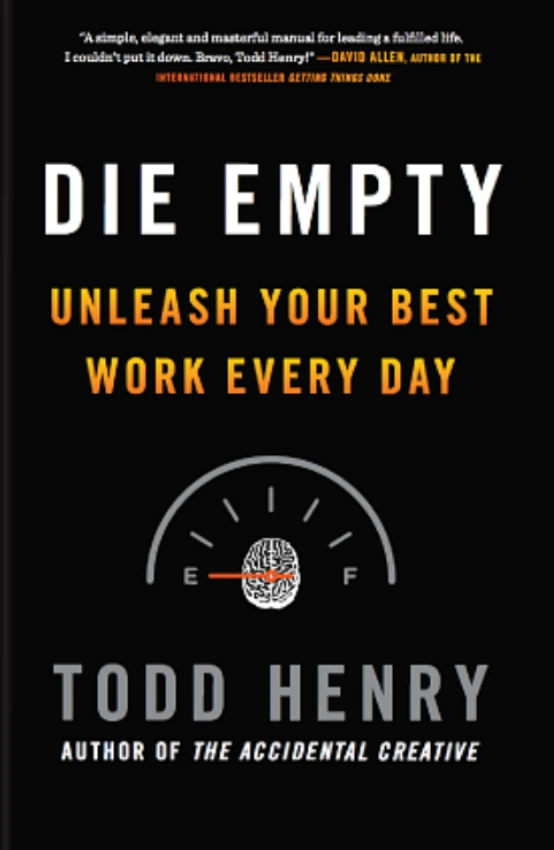
Go deeper with Die Empty. Every principle here is unpacked in the book, with stories, exercises, and the full checkpoint. It was named one of Amazon’s best business books of 2013. Read two free chapters or explore the book.
Bring these ideas to your team. Die Empty is also a keynote that helps teams break the patterns that stall talented people.
Explore the keynote
Todd Henry
Todd teaches leaders and teams how to be brave, focused, and brilliant. He’s the author of seven books, including Herding Tigers and The Brave Habit, and host of the Daily Creative podcast.