
A few years ago, I started running. I have always hated running, and I want to be clear that I still don’t enjoy it. But I decided to take it up anyway, and I kept at it, a little every day. Two years later, something strange had happened. A day without running felt wrong. If I hadn’t run by the end of the day, it seemed like something was off. I hadn’t become a different person, and I hadn’t discovered some hidden reserve of willpower. I had simply built a practice, and the practice had quietly reshaped me.
That’s how most meaningful change happens, in our creative work and everywhere else. It rarely comes from a dramatic decision or a burst of inspiration. It comes from small things done consistently, day after day, until they become part of who we are. I wrote Daily Creative as a collection of short daily entries for exactly this reason: brilliant work isn’t built in a day, but it is built daily.
What follows is a walk through why daily practices matter so much, with a few entries from the book along the way. Read it slowly, and pay attention to the one or two practices that you know you’ve been avoiding. Those are usually the ones you need most.
DisciplineDiscipline is simply a promise kept.
We tend to believe that some people are just disciplined and others aren’t. The reality is that most of the people we think of as disciplined aren’t naturally that way. Like everyone else, they would drift back toward comfort if they let themselves. The difference is that they have practices that keep them from doing so, and over time those practices become the expectation rather than the exception.
The word discipline can feel heavy. To some it implies the grind, sweat and sacrifice. To others it sounds like guilt, something you ought to do but probably won’t. I’d like to make it simpler than that.
Discipline simply means to make an agreement with yourself, a promise to yourself, and then keep it.Daily Creative · November 25
If you agree to run for two minutes and you do it, you are disciplined. If you say you’ll write fifty words a day and you write them, you are disciplined. Most of us get into trouble not because we lack discipline, but because we make promises to ourselves that we were never going to keep. We plan to write 2,500 words on Tuesday, then something comes up, and we end the day feeling like failures. The answer isn’t more guilt. It’s more honest promises, kept consistently.
Your practices provide the infrastructure for creative discipline.
RitualsWe make our rituals. Then our rituals make us.
A few years ago, a wave of books promised to reveal the daily rituals of famous achievers. Readers rushed to learn what a billionaire ate for breakfast or which coffee a famous executive preferred. It’s understandable to want to know how the people we admire structure their lives, but we often mistake correlation for causation. It isn’t their specific rituals that made them successful. It’s that they actually have some.
Rituals are a bounding arc that keeps you moving in the right direction, day by day. When the world was upended by the pandemic, many of us discovered how true that is. Those who had built steady rituals of study, reflection, writing, and connection held onto a stability that only regular disciplines can provide, even as everything around them changed.
Don’t worry about the rituals of others, but make certain that you have some of your own.Daily Creative · September 28
Getting startedFind the trigger, and the rest will follow.
It’s easy to overcomplicate habits. The choreographer Twyla Tharp has written that her daily habit isn’t the workout itself. It’s hailing the cab that takes her to the studio. Once she’s at the curb with her hand in the air, the rest happens on autopilot. The hardest part is simply getting started, so that’s the part she makes automatic.
Most of your valuable rituals can probably be simplified down to a single trigger action. For me, every time I write, I light a candle. Not just any candle, but one particular scent that I go through several times a year, and I only light it when I’m writing. It sends a signal to my brain that it’s time to begin, and once it’s lit, I’m already on my way. What small action could serve as the cab, or the candle, for the work you keep putting off?
Steady progressDon’t aim for ideal days. Aim for effective ones.
Benjamin Franklin famously wrote out his ideal day, beginning with hours of study and reflection and ending with a review of what he’d accomplished. People quote it often as a model for planning our time. But I have to wonder how many of those ideal days Franklin actually experienced. Predictability is possible where certainty abounds, and in creative work, certainty rarely abounds.
Still, you must have some predictability. You may not control all of your time, but you need to control some of it. Simply knowing when you’ll do your most important work releases an enormous amount of pressure. That’s also why I push back on the old saying that slow and steady wins the race. Slow and steady alone does not win. Slow, steady, and deliberate wins, punctuated by occasional sprints. Daily progress only matters if it’s moving in a meaningful direction, so define what meaningful progress looks like today, then go make it.
Build your dailies
Choose two or three.
Not everything on this list. Just the few practices you’re willing to promise yourself every day.
MorningsRoot yourself in possibility.
There is nothing as thrilling as the moment of inspiration, and nothing as quick to crush it as the reality of what it might take to bring an idea into the world. If you’re not careful, the tender seedling that just sprouted gets trampled under the boot of pragmatism. That’s why I believe in spending a few moments each morning dwelling in possibility.
About fifteen years ago, my friend Lisa Johnson encouraged me to write a list of things that would blow my mind if they actually happened, and to review it regularly. They were career ambitions, relational goals, personal experiences, anything that excited me. I reviewed that list every morning, and remarkably, most of the items on it have happened. There was nothing magical about the list. What mattered was the daily habit of rooting myself in what could be rather than in what is.
Another morning practice I recommend comes from Julia Cameron’s The Artist’s Way. She calls it Morning Pages: three longhand pages of free writing each morning before any other creative work. There are brilliant ideas lurking just beneath the surface of your conscious thought, and you miss them because you’re busy handling your responsibilities. Spilling your mind onto the page each morning clears the clutter and lets those ideas rise. The pages are for no one but you.
Checking inDon’t just move through your life. Manage it.
When work and obligations pile up, it can feel like you’re being carried along by a current you can’t influence. One antidote is a short daily check-in, a handful of questions you ask yourself to find an island of calm in the middle of the storm. Here are a few from the book. Keep them in front of you, and pick a consistent time each day to run through them.
The daily mental checklist
A few questions before the day runs you.
Check each one off as you answer it.
Small momentsBe purposeful in the small things.
I used to be a drip coffee guy. Then a friend introduced me to the French press, with its precise water temperature, freshly ground beans, and patient brewing time. It takes longer, but I’ve come to love that moment in my day. It slows me down so I don’t leap straight into my work, and I do a surprising amount of thinking while I make it. It has become meditative.
Building a few of these crafted moments into your day can make a real difference to your creative process. Maybe it’s preparing your lunch, lighting a candle, or setting your desk in order for tomorrow. Choose one or two small activities and approach them with craft and care. They force you to slow down and pay attention, and attention is where good ideas begin.
RutsA ritual is a rail, not a magic formula.
There is a warning that comes with all of this. I grew up hearing that a rut is just a grave with open ends, and I didn’t fully understand it until I entered the workplace. I sat at the same desk, went to the same meetings, and had the same conversations about the same problems, week after week. When I began studying people who were consistently effective, I found that their circumstances often weren’t much different from mine. What was different was their mindset. They saw past the activity to the intent behind it. They refused to let their rituals become ruts.
Your systems and rituals exist only to serve the outcome you’re trying to achieve. They are guide rails, not the destination. When a practice stops serving the work, change it. When it still serves the work but you’ve stopped paying attention, recommit to the reason you started.
Strive to fall in love with the process, not just the end results.Daily Creative · February 14
You will become known for the work you produce. That’s inevitable. But the process that produces it is far more substantial to your life than any result others will see. If you fall in love only with the results, and especially the recognition, you’ll treat the work as a means to an end. If you fall in love with the process, your work becomes self-fueling, and every step renews you. Ironically, you’ll probably produce better results, too.
I still don’t love running. But I love who I’ve become because I kept showing up, and that’s the quiet promise of every daily practice. You won’t notice much on any single day. Then one day you’ll look up and realize that the practice has become part of you, and that the work you once struggled to start now feels strange to skip.
Brilliant work isn’t built in a day, but it is built daily.
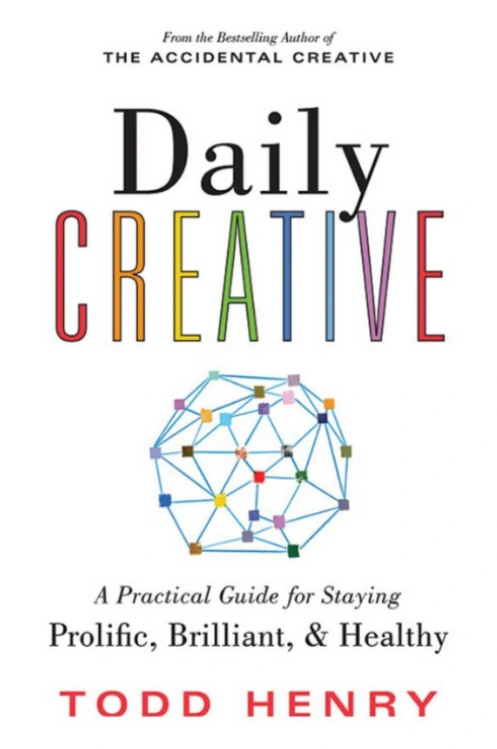
Go deeper with Daily Creative. The book offers a short entry for every day of the year, each with a question to help you put it into practice. Explore the book or listen to the Daily Creative podcast.
Bring these ideas to your team. Brilliance Under Pressure is a keynote that helps teams build the daily rhythms that make great work consistent.
Explore the keynote
Todd Henry
Todd teaches leaders and teams how to be brave, focused, and brilliant. He’s the author of seven books, including Herding Tigers and The Brave Habit, and host of the Daily Creative podcast.