A few years ago, trying to escape the Florida heat at Disney World, I ducked into a gift shop and found myself standing under an air conditioning vent, staring at a bright red T-shirt. Across the top were the words “How to Draw Darth Vader,” followed by four panels. Panel one: start with a head and body, shown as a crude stick figure. Panel two: add a cape. Panel three: draw the face, gloves, and boots, still barely more than a cartoon. Panel four said, “Add details and some shading. FINISHED!” and above it was a perfectly photo-realistic Darth Vader. I still laugh when I think about it.
That shirt is a great picture of how most leadership advice gets handed out. Have a clear vision. Hire talented people. Listen more than you speak. And voilà, brilliant work pops out the other side. Except it doesn’t. The real mechanics of leading creative work are far more complex than our neat clichés can handle. Creative work has to be figured out as you go, and leading the people who do it means living in that complexity every day.
You’ve probably heard that leading creative people is like herding cats. I strongly disagree, and I find the comparison a little demeaning. If you’ve hired brilliant, driven people, it’s more like herding tigers, powerful beings who can’t be corralled but must be carefully, individually, and strategically led. That is the work of Herding Tigers. What follows is a walk through the book’s core ideas, the step-four details that turn a team of talented individuals into a team that does brilliant work together.
What they needCreative people need stability and challenge.
There are a handful of myths about creative people that get in a leader’s way. The most common is that they want total freedom. In my experience the opposite is true. Creative people crave boundaries, because a wide-open field isn’t helpful to the creative process. What they need from you more than anything else are two things that sound like opposites: stability and challenge.
Stability comes from clarity and protection. Your team needs you to be clear about your expectations, even when you’re not certain they’re the right ones, so they aren’t worrying about rework and wasted time. They need to know what you value and how good work will be recognized. And they need to know you have their back, that you will stand up for them in the rooms they aren’t in, and that you will never throw them under the bus. Challenge comes from permission and faith. Your team needs to hear that you don’t just allow them to take risks, you expect it. And they need to believe that you have faith in them, which means you have to back up your words by getting out of their way.
If you want your team to do great work, you need to take the first risk by giving it clear direction.
The stability and challenge matrix
Four places a team can live, and only one where it thrives.
Think of stability along the bottom and challenge up the side. Every team drifts among these over time.
- Thriving · high stability, high challengeClear expectations and protection, plus permission to stretch. The team comes alive.
- Angry · low stability, high challengePlenty of challenge, but unclear direction and no cover. People grow jaded and frustrated.
- Stuck · high stability, low challengePredictable and safe, but boring. Talented people start looking for greener pastures.
- Lost · low stability, low challengeNo clarity and nothing to push against. Teams rarely survive here for long.
Your team today
Which quadrant describes your team?
Not on its best day, and not the way you’d describe it to your boss. Where is it living right now?
Choose one. If you see anger, look first at stability. If you see boredom, look at challenge.
Maker to managerYour job is not to do the work. It’s to lead the work.
You probably earned your promotion because you were exceptional at the work. That’s exactly what makes the shift to leadership so hard. The skills that got you here won’t get you where you need to go, and if you keep doing the team’s tactical work, you are failing it as a leader, because the capacity of your team will never scale beyond you.
I once asked a manager I’ll call Jason why he felt the need to micromanage his team of designers and writers. After some hesitation, he admitted he didn’t trust them. He had been burned by a few bad hires early in his career, and his reputation was on the line. The result was that his team’s world had shrunk to the size of his perspective. They were frustrated, unmotivated, and underperforming, and his insecurity had placed an artificial cap on their growth.
So if you’re not supposed to do the work, what exactly do you do all day? Your job is to provide your team with three things. If your team isn’t running like a well-oiled machine, one of them is almost always missing.
Your role as the leader
Focus, function, and fire.
Seven simple questions. If you can’t answer one of them clearly, your team probably can’t either.
Focus
Ensuring the team’s attention is on the right problems at the right time. What are we doing? What are we not doing? When are we doing it?
Function
Ensuring the team has the resources and processes it needs. How will we do it? What do we need in order to do it?
Fire
Keeping the team motivated by tying what it’s doing to why it matters. Why are we doing it? What will it mean?
Influence and controlInfluence scales. Control doesn’t.
When you become a leader, you move from being accountable for your own work to being accountable for work you don’t directly control. Many leaders respond by tightening their grip. Control feels safer, because it avoids uncomfortable conversations and the possibility of short-term failure. But when you try to control bright, talented people, they eventually go looking for better horizons, because they get tired of bumping into your ceiling.
Brian Koppelman, the co-executive producer and showrunner of Billions, told me he simply can’t be everywhere at once on a production that large. Because his and his partner’s vision is clear and well communicated, and their team understands how and why they make decisions, they can lead a huge collective of talented people through influence instead of micromanagement. Influence leads by vision, while control leads by sight. Influence is about care and spreading praise, while control is about self-interest and claiming credit.
That kind of influence depends on giving people a clear target. Many leaders operate like a lighthouse. They warn the team about the rocks, telling them where not to go, but never point to the destination. Great leaders act more like a laser, pointing clearly at where the team needs to end up and then trusting the people on the boat to figure out how to get there.
Trust and cultureTrust is the primary currency of creative teams.
Trust isn’t static. You can earn it over years and lose it in an afternoon. A few simple disciplines protect it. Don’t declare what you can’t control or don’t yet know, because every confident prediction that turns out to be wrong costs you credibility. Don’t try to be a superhero who has all the answers, because your team will trust you more when you invite them to help solve the problem. Protect your team’s resources, tell a good story about where the work is going, and be willing to change your mind when you’re wrong.
Trust lives inside a culture, and culture isn’t the list of values engraved on the marble wall in the lobby. It’s what you tolerate and what you reward. Think of yourself as a gardener. You prune by refusing to accept the small compromises that slowly erode a team, like missed deadlines that become normal, meetings that get skipped, a disrespectful tone, or people talking about a colleague behind their back. I was once caught off guard when someone on my team joked that if you had a meeting scheduled with Todd, there was about a fifty percent chance it would actually happen. Then you fertilize, by rewarding the behavior you want to see at scale, so that what you say you value and what you actually celebrate are the same thing.
MarginBrilliant ideas emerge in the white space.
Try counting from one to twenty while solving 420 divided by 5. Unless you’re a savant, you can’t do both at once, because your mind can only fully engage one task at a time. Yet many organizations value efficiency over every other measure, simply because efficiency is easy to measure. They fill every available minute and then wonder why the ideas have dried up.
Innovation and creative breakthrough often happen in the white space, when your team is able to step back, process, play with ideas, and experiment. When there is no margin, there is no room for deep thought. As the leader, you are your team’s freedom fighter. Refuse to let the steady ratcheting up of meetings, side projects, and incremental requests consume its energy. Build buffers for attention and time, and measure productivity over intervals rather than in snapshots. If you treat your team like a machine, that’s exactly what it will become.
Be the musePlant seeds before you harvest.
The team that landed the Curiosity rover on Mars succeeded in part because it was willing to entertain ideas that sounded absurd at first. The environment you create determines whether your team can generate great ideas under pressure, and whether the best ideas actually win. If you want to reap a harvest later, you have to plant seeds now. Feed your team a steady stream of books, articles, and stories from parallel fields. Bring in outside perspectives. Push people gently outside their comfort zones, and create space for them to champion the ideas that excite them.
And don’t be afraid of conflict. I once asked a manager how his team handled disagreement, and he proudly told me they never argued. Every part of me wanted to tell him that was the least healthy thing I’d heard all week. Your team is not a family, and you shouldn’t treat it like one. Healthy teams fight, but they fight fair, with compassion and clear rules, and they do it over ideas rather than over each other.
A weekly leadership check
Five questions before Monday.
Check each one off as you answer it for your team.
YouBe a leader worth following.
Enough about your team. Let’s talk about you. How much of the work you do each day will you be proud of in ten years? I don’t mean whether your client was pleased or your idea won. I mean whether you’ll be able to look back with pride on the choices you made to bring that work into the world, and on the people you brought along with you. Many people never define success clearly, so they spend their careers chasing vapor. Leading with integrity means your life is integrated, so that there is no gap between what you say you value and what your actions prove.
My family and I live in Cincinnati, which takes its name from a Roman farmer named Cincinnatus. Rome called on him to lead in a moment of crisis, and he did, winning a decisive victory. That alone would make him memorable. What made him a legend is what happened next. At the height of his power, when he could have demanded anything, he gave up his authority and went home to his farm. Your role is not who you are. It’s simply the way you lead for a season, and the leaders worth following are the ones who hold it loosely.
Go back to that T-shirt for a moment. The joke works because everyone knows the real drawing lives in step four, in the details and the shading that no one bothers to explain. Leadership is the same. Vision and talent matter, but the brilliance your team produces will come from the hundreds of small, faithful choices you make every week to give them stability, challenge, and a leader they can trust.
Lead the work, not just the people doing it, and you’ll unleash their brilliance.
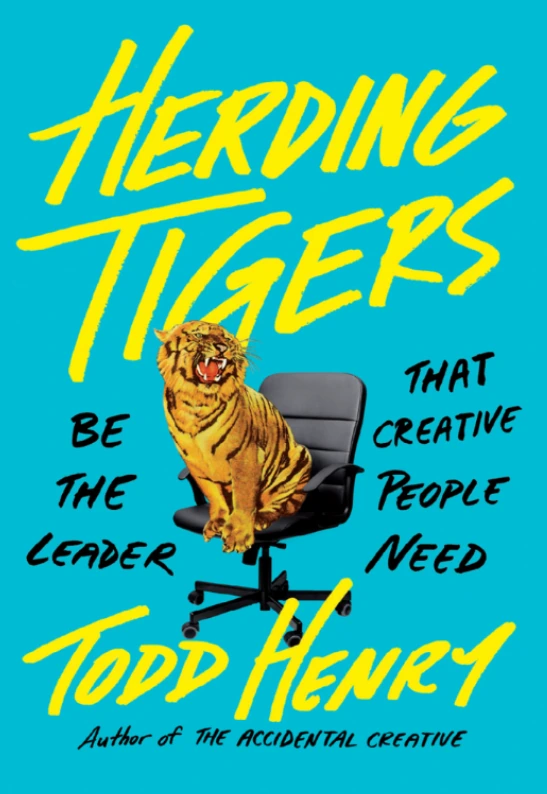
Go deeper with Herding Tigers. Every principle here is unpacked in the book, along with dozens of weekly and monthly rituals for leading creative teams. Take the free Herding Tigers assessment or explore the book.
Bring these ideas to your team. Herding Tigers is also a keynote and workshop that helps leaders give their teams the stability and challenge they need to thrive.
Explore the keynote
Todd Henry
Todd teaches leaders and teams how to be brave, focused, and brilliant. He’s the author of seven books, including Herding Tigers and The Brave Habit, and host of the Daily Creative podcast.