In the early 1960s, a lanky teenager in Medford, Oregon, was losing at the high jump. His name was Dick Fosbury, and he was not very good. Every serious high jumper in the world used the same technique. You ran at the bar, kicked one leg up, and rolled over it face down. It was called the straddle, and it had been the standard for decades. Dick Fosbury could not make it work. He kept clipping the bar. He kept finishing near the bottom.
So at a meet during his sophomore year, he tried something nobody had seen. He ran at the bar, turned his back to it, and went over headfirst, facing the sky, arching his spine and kicking his legs up at the last second. It looked ridiculous. One local paper described him as a fish flopping in a boat. His coaches told him to go back to the straddle. Officials checked the rulebook to see if what he was doing was even legal. People in the stands laughed.
Medford, Oregon · 1963
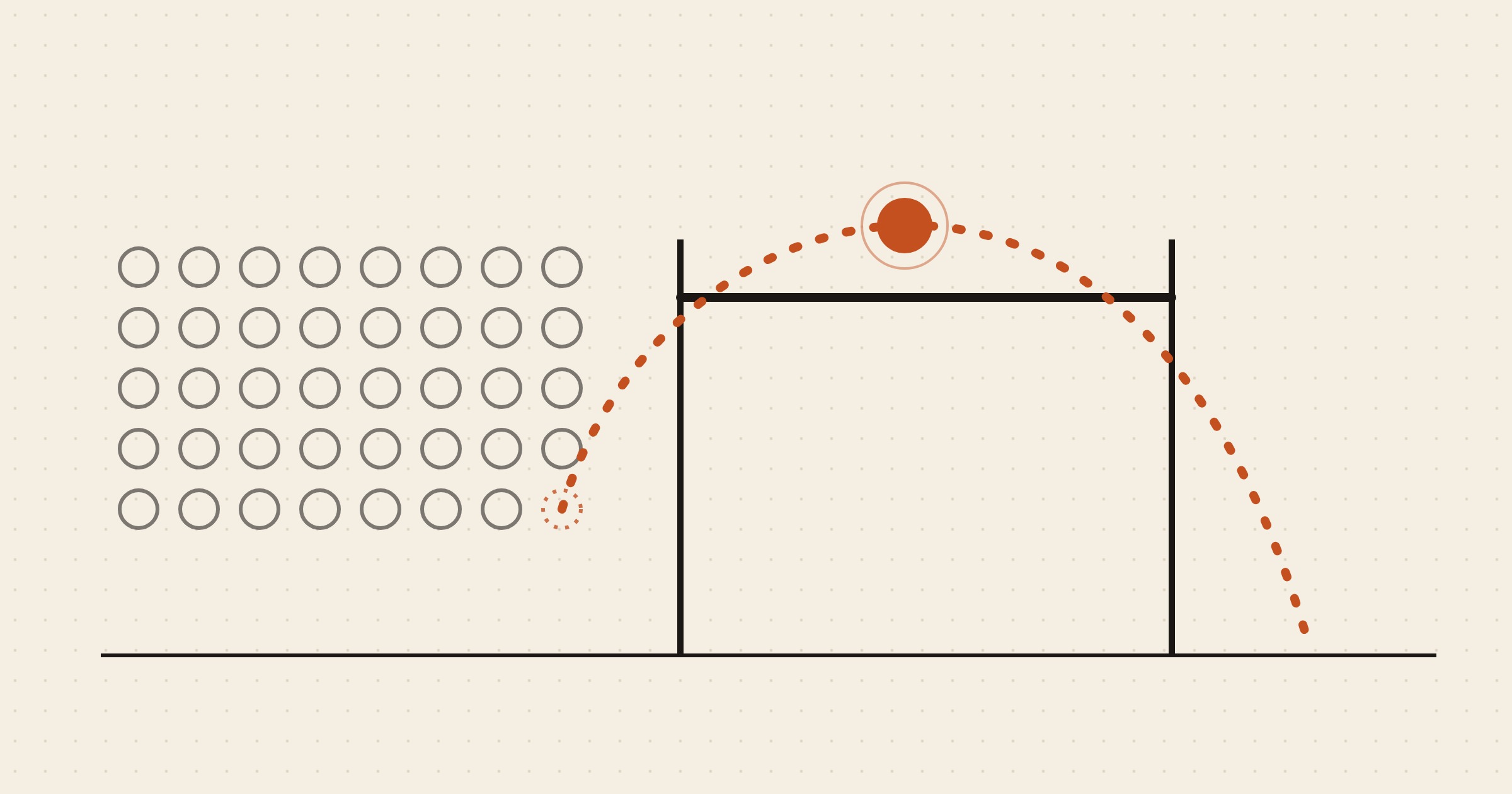
The technique everyone laughed at. It worked with the body’s center of gravity instead of against it.
But the bar kept going up. The technique, which worked with the body’s center of gravity instead of against it, let him clear heights the straddle never could. And in 1968, in Mexico City, Dick Fosbury won the Olympic gold medal with a jump of 2.24 meters, an Olympic record. The crowd that had laughed four years earlier stood and cheered.
The bar kept going up. The crowd that laughed in Oregon stood and cheered in Mexico City.
Within a decade, almost every elite high jumper in the world was doing what Fosbury did. Today, the straddle is extinct. The thing that made him look foolish became the only way anyone jumps. It has a name now. It is called the Fosbury Flop.
He became the best by doing a thing that only he could do, in a way that only he could do it, and holding onto it long enough for the world to catch up.
Dick Fosbury did not become the best high jumper in the world by doing the standard thing better than everyone else. That matters more right now than it has at any point in your creative life.
What the singularity is
The word singularity gets thrown around in conversations about AI, and plenty of people nod along without being entirely sure what it means. It deserves a plain definition.
1.In physics, a point, like the center of a black hole, where the normal rules stop working and our ability to predict what happens next breaks down.
2.In technology, the hypothetical moment when machine intelligence surpasses human intelligence and begins improving itself faster than we can follow. Past that point, change becomes so rapid and so strange that we cannot see beyond it.
In the 1950s the mathematician John von Neumann applied the physics idea to technology. He observed that progress was accelerating toward a point beyond which human affairs as we know them could not continue. Later thinkers, most famously the inventor Ray Kurzweil, gave the idea its popular form.
The singularity that concerns you
Competent is now free.
Whether or not the dramatic version ever arrives, something real is already happening. Tools that can write, design, compose, code, and illustrate are available to anyone with an internet connection, and the cost of producing competent creative work has collapsed toward zero.
If you are a creator, that is the singularity that concerns you. Not a distant event on a timeline, but a present reality in which the baseline of what counts as good enough is being generated instantly, everywhere, by everyone.
If your work is merely competent, if it is good but indistinguishable from what a machine can produce in seconds, you are standing in the center of that collapse. The question is not whether AI will get better. It will. The question is what you are going to do about it.
My answer is that you have to become singular.
What it means to be singular
The word singular has a few meanings, and I want all of them. Singular means one of a kind. It means remarkable, set apart, the only one of its sort. It also carries that physics meaning, a point where the ordinary rules do not apply. When I say you need to become singular, I mean that your work needs to be the kind of thing that could not have come from anyone else, and therefore could not have come from a machine trained on everyone else.
A machine’s output is uniform by design. Singular work is the one that is unmistakably itself.
I have said for years that cover bands don’t change the world. A cover band can be tight. A cover band can be talented. A cover band can fill a room on a Saturday night. But nobody drives across the country to hear a cover band, and nobody’s life is rearranged by one, because a cover band is reproducing something that already exists. They are playing someone else’s songs. You already know how the song goes before they start.
That phrase used to be a warning about imitating the people you admire. Now it is a warning about something much bigger. AI is the ultimate cover band. It has learned every song ever written and it can play any of them on request, in any style, at any tempo, instantly. It is extraordinarily good at reproducing the average of everything that came before. If you are competing with it on that ground, you will lose, because it is better at being generic than you will ever be.
Cover bands don’t change the world.A machine cannot stand on the stage of your life, with your scars and your convictions and the specific people you love, and say the thing that only you have earned the right to say.
But it cannot write your song. Dick Fosbury did not win by doing a better straddle. He won by doing the thing that was his.
So how do you do that? How do you develop a voice that is unmistakably yours in an age of infinite imitation? That is what the rest of this is about.
Wear the idea
Take the message with you.
The two key lines from this article are now Daily Creative t-shirts. Cover Bands Don’t Change the World and Become Singular come in dark and light versions, printed on soft, everyday tees and shipped by Printful.
Buy the shirts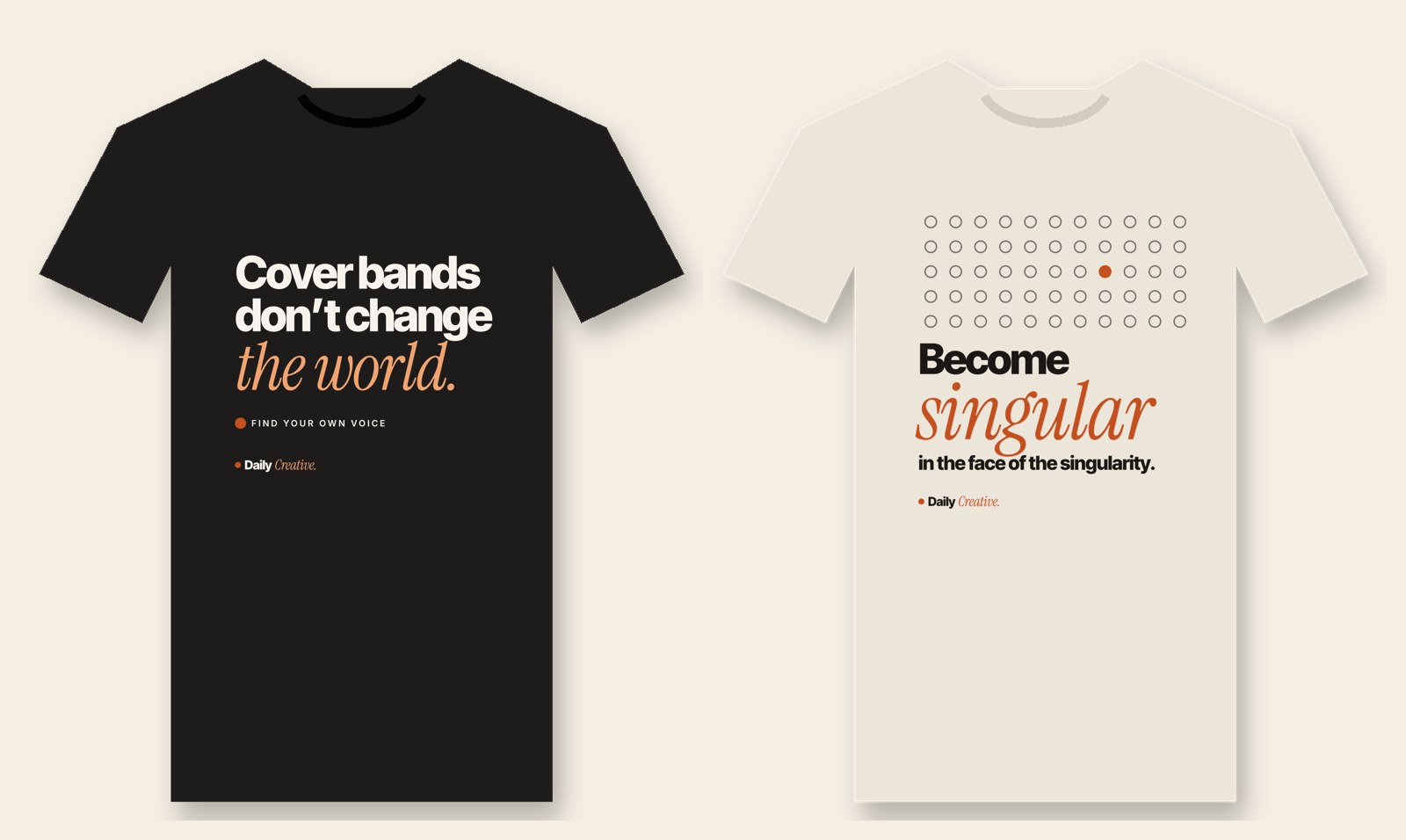
Voice: the first principle of VERVE
What follows comes from a body of work I call The Infinite Lever. It is about the human skills that become more valuable, not less, as AI gets better, and at its center is a framework I call VERVE. Each letter stands for a capacity that machines struggle to replicate, and the first one, the V, is voice. Voice is where everything else begins, because it is the question of whether anyone can tell your work is yours.
Years ago I wrote a book called Louder Than Words that was entirely about developing an authentic voice. The core of that work belongs here, because the landscape has changed and those principles matter more now than when I wrote them. A real voice is built on five things. Authenticity, uniqueness, precision, empathy, and timing.
Authenticity
Authenticity means skin in the game.
People hear that word and think it means being transparent or being relatable. That is not what I mean. Authenticity means skin in the game. It means that your work shows people what you actually care about, that you are willing to risk something on behalf of what matters to you, and that you keep caring even when it costs you. Fosbury kept jumping backward while people laughed and coaches told him to stop. That is authenticity.
AI has nothing at stake. It cannot be embarrassed, it cannot be wrong in a way that hurts, and it cannot sacrifice for anything. When your audience can see that you have put something on the line, they lean in, because risk is the one thing that cannot be faked at scale.
Try thisSay one thing publicly this week that you believe and that carries some cost: a position a client might not love, a standard you intend to hold.
Uniqueness
Uniqueness comes from your pillars.
You have a set of unique pillars, and your job is to identify them. Your pillars are the places where your passion, your skills, and your experiences overlap in a way that is true of no one else. Plenty of people share one of those with you. Very few share all three. The intersection is where you stand above everyone else, not because you are better at everything, but because you are the only one standing in that exact spot.
If you have never done the work of naming your pillars, do it this week. Write down what you cannot stop caring about, what you are measurably good at, and what you have lived through that most people have not. Then look at where they overlap. That is your ground. Build there.
Precision
Precision means the exact word.
Pay closest attention to this one, because it is where AI is weakest and where most creators are lazy. AI is spectacularly good at speaking generally. Ask it for advice on leadership and you will get a smooth, reasonable, forgettable paragraph that applies to everyone and lands with no one. Precision means you say exactly what you mean. Not the general version. Not the safe version. The specific thing, with the specific word, aimed at the specific moment.
Generality is the sound of a cover band. Precision is the sound of your song.
The difference between a good creator and a singular one is often a single sentence that says what everyone else was circling around.
Empathy
Empathy means one person.
I do not mean a vague sense of compassion for your audience. I mean that you have a specific target. Not an audience, but a person. When you sit down to create, you are picturing one human being, someone you know or can describe in detail, with a real problem and a real life, and you are making this thing for them. When you create for a demographic you produce content. When you create for a person you produce resonance. That person feels seen, and so does everyone like them, because specificity travels.
AI can model an audience. It cannot love a person.
Timing
Timing means the right moment.
There is a nuance to knowing when to say what, and it is almost entirely absent from machine-generated work. Timing is knowing that this idea is right but this week is wrong. It is knowing that your audience is grieving, or celebrating, or exhausted, and shaping what you say around what they can actually receive. It is the comedian’s pause, the pastor’s silence before the hard sentence, the leader who waits a day before sending the email.
AI can produce the right words. It has no sense of the right moment. You do, if you are paying attention, and that attention is a competitive advantage that no model can close.
Authenticity, uniqueness, precision, empathy, timing. Skin in the game, your pillars, the exact word, the one person, the right moment. That is a voice. And a voice is the first and most important thing that makes you singular, because a voice is the one thing in the room that cannot be a cover.
Back to the bar
Four years passed between the day Dick Fosbury first flopped over a bar in Oregon and the day he stood on the podium in Mexico City. Four years of looking foolish. Four years of people who knew better telling him to do it the normal way. He had no proof it would work. He only had the growing sense that this was the thing that was his, and the willingness to keep doing it in public before anyone understood.
That is what being singular costs. It is not a branding exercise. It is the daily decision to put skin in the game, to build on your own pillars, to say the precise thing, to make it for one person, and to trust your sense of the moment, all while the world around you is flooded with competent, instant, forgettable work that looks a lot like what you could have made if you had taken the easy road.
The singularity, whatever form it takes, will be very good at producing the straddle. It will produce the standard thing, done well, at a scale we cannot comprehend. What it will never produce is the strange, risky, unmistakably human thing that makes a crowd stop laughing and start cheering.
This week’s challenge
Could anyone else have made this?
Pick one piece of work you are about to make and ask yourself that single question. If the answer is yes, go back to it. Find the place where it stops being a cover and starts being your song. Then jump backward, and keep jumping until the world catches up.
Cover bands don’t change the world. Be singular in the face of the singularity. Go make something only you could make.
The Action Guide
It’s not what you know. It’s what you do.
This article comes from episode 130 of Daily Creative, and every episode comes with an Action Guide: the big idea in a page, six practices you can finish before the next episode, questions for yourself and for your team, and a place to write down the one step you will take this week.
Hear the full episode. Being singular, the five elements of voice, and the one question to ask before you ship.
Listen to episode 130
Todd Henry
Todd teaches leaders and teams how to be brave, focused, and brilliant. He’s the author of seven books, including Herding Tigers and The Brave Habit, and host of the Daily Creative podcast.