Manifesto examples

Manifesto examples, and how to write your own.

A manifesto is a short set of principles that says what you stand for and how you intend to do your work. Below you’ll find original examples for leaders, teams, solo professionals, and students, my own personal manifesto, famous manifestos worth reading, and a simple method for writing yours.

Manifesto examples

Four manifestos
you can learn from.

Each of these is written for a different kind of work. Read them for the pattern, not the words: a short command, then a sentence that explains why it matters. The best manifesto is the one that sounds like you, so borrow the shape and write the rest yourself.

A creative leader’s manifesto

Lead the way you’d want to be led.

  1. Protect the work.Guard your team’s focus like the scarce resource it is.
  2. Go first.Never ask for a risk you aren’t willing to take yourself.
  3. Be clear.Ambiguity feels like freedom but works like fog. Say what you expect, then say it again.
  4. Make it safe to be wrong.The best ideas rarely show up in rooms where mistakes get punished.
  5. Raise the bar and stay close.Ask for the team’s best work, then stand beside the people who have to deliver it.
  6. Give the credit away.Your job is to make other people look brilliant.
  7. Leave it better.Measure your leadership by who your people become.

A team manifesto

How we work together.

  1. We start with the problem.We agree on what we’re solving before we argue about how.
  2. We say it in the room.Disagreement belongs in the meeting, not the hallway.
  3. We commit once we decide.We can disagree and still row in the same direction.
  4. We protect each other’s time.Every meeting has a purpose and an end.
  5. We finish things.Done and improving beats perfect and pending.
  6. We assume good intent.When something goes sideways, we ask before we accuse.
  7. We celebrate progress.Small wins, named out loud, keep big work moving.

A solo professional’s manifesto

Build a body of work, not just a business.

  1. Own your calendar.If you don’t decide where your time goes, your inbox will.
  2. Plant every week.Do something for the work you want next, even when you’re busy with the work you have now.
  3. Choose your clients.Say no to good opportunities so you have room for great ones.
  4. Price the value.You’re paid for the result, not the hours it took.
  5. Ship on schedule.Reliability is the most underrated creative skill.
  6. Keep learning.Spend part of every week getting better at something no one is paying you for yet.
  7. Rest on purpose.Recovery is part of the work, not a reward for finishing it.

A student manifesto

How I learn.

  1. Be curious before you’re certain.Ask one more question than feels comfortable.
  2. Show up.Most of what you learn happens because you were in the room.
  3. Do the reading, then argue with it.Understanding comes before opinion, but forming an opinion is the point.
  4. Make mistakes early.A bad grade on a draft costs far less than a bad habit you carry into a career.
  5. Find your people.Study with those who make you better, not just busier.
  6. Guard your sleep.A rested mind learns faster than a tired one works.
  7. Make something you’re proud of.Grades fade. The work you made stays with you.

A real example

My personal manifesto.

I first published this on the one-year anniversary of Louder Than Words. It’s always a work in progress, but I review it regularly to remind me of what matters and what I need to do about it.

01

Bring your passion.

Brilliant work is the accumulation of a lot of small victories over apathy. Don’t seek your passion, grow it.

02

Be ordered.

Your daily personal habits and rituals determine your destiny.

03

Do what works.

“Coolness” is overrated. Don’t aspire to be cool, aspire to be effective. Chasing trends is chasing your own tail.

04

Be fiercely curious.

Never get stuck because of a knowledge gap. Ask questions and seek answers until your next move is clear.

05

Run your race.

Don’t worry about what others are doing. You aren’t accountable for their work, and they’re not accountable for yours.

06

Be real.

Make things you love for people who will love them. Invest yourself fully into your work. Don’t aspire to serve everyone.

07

Stand firm.

Don’t try to change the world. Do try to change something. Don’t be afraid to offend. Your scars are marks of honor.

08

Let go.

A hundred years from now, you’ll be dead and no one will remember that thing you’re stressed about today. Don’t let circumstances control you.

09

Choose love.

In any situation, ask “What does love demand of me in this moment?”, regardless of how difficult or unpopular the decision might be.

More on why I wrote it: How a Personal Manifesto Helps You Make Better Decisions ›

Why write one

A manifesto isn’t a playbook.
It’s a compass.

It won’t tell you what to do in every situation, and it isn’t supposed to. It gives you a small set of principles to make decisions by, so the work you do every day lines up with what you say you believe.

It reminds you of your values.

It names what you’re unwilling to compromise for short-term gain, before the pressure to compromise shows up.

It simplifies your decisions.

In a complex world, it gives you a simple set of rules to live by, so you know which opportunities to take and which to pass on.

It shows others what matters.

People should be able to look at how you lead, write, talk, and collaborate and see what you care about. A manifesto makes you more consistent.

Famous manifestos

Nearly two centuries
of writing it down.

Artists, writers, designers, software developers, and companies have all used manifestos to say what they believe. These are some of my favorites. Each link opens the original or a trusted source, so you can read them in full.

1847 · Personal

Rules for life

Leo Tolstoy

As a young man, Tolstoy set down a list of rules for himself in his diary. It’s a reminder that even great writers started by deciding who they wanted to be.

Read it ›
c.1968 · Students and teachers

Immaculate Heart College Art Department Rules

Sister Corita Kent

Ten rules plus a few hints for students and teachers, written by the artist and educator for her class. Often credited to John Cage, who helped make them famous. One of the best student manifestos ever written.

Read it ›
1998 · Creative work

An Incomplete Manifesto for Growth

Bruce Mau

Forty-three points on sustaining a creative practice, from process over outcome to going deep. Proof that a manifesto can be long and still feel alive.

Read it ›
2001 · Teams

Manifesto for Agile Software Development

Seventeen software developers

Four value statements and twelve principles that changed how teams build software. A model for a team manifesto that weighs one value against another.

Read it ›
2009 · Life

The Holstee Manifesto

Dave and Mike Radparvar, Holstee

Written by two brothers on the steps of Union Square as they started a company, it became one of the most shared manifestos online.

Read it ›
2009 · Getting things done

The Cult of Done Manifesto

Bre Pettis and Kio Stark

Thirteen points against perfectionism, written in about twenty minutes, which is exactly the point.

Read it ›
Craft · Discipline

The Lunch Pail Manifesto

Steven Pressfield

Ten points on the ethic of the workaday artist, who treats every day as a chance to practice the craft. A copy hangs on my office whiteboard.

Read it ›
Design

Ten principles for good design

Dieter Rams

Ten short statements about what makes design good. A manifesto doesn’t have to say “manifesto” on top to work like one.

Read it ›
Company

The lululemon manifesto

lululemon

The company’s beliefs, printed on its shopping bags and walls. A look at how a brand turned its manifesto into something customers carry around.

See it ›

How to write a manifesto

Write your own
in five steps.

In Louder Than Words, I describe three drivers of an authentic voice: Identity, Vision, and Mastery. Your manifesto lives in the first one. Identity answers the question “Who are you?”, and a manifesto is how you distill that answer into a handful of core tenets you can actually live by.

Identity Who are you? Vision Where are you going? Mastery How will you get there? Your manifesto lives here The Voice Engine, from Louder Than Words
  1. Look back before you look ahead.

    Your identity isn’t something you invent. It’s something you uncover. Look at the work you’re proudest of and the moments when you felt most alive in it, then look for what they have in common. The beliefs that belong in your manifesto are usually already showing up in your best work.

    Ask yourselfWhen has my work felt most like me? What was true about how I did it?

  2. Name what you won’t compromise.

    Pressure has a way of pulling you off course a little at a time. Decide now which values you refuse to trade for short-term gain, because those are the lines your manifesto has to protect.

    Ask yourselfWhat would I regret trading away for a bigger paycheck, an easier week, or a quick win?

  3. Write each belief as a tenet.

    A good tenet has two parts: a short command you can remember, followed by a sentence that explains why it matters. The command is what you’ll recall in the moment. The reason is what keeps it from becoming a slogan.

    Try thisFinish the sentence “I will always…” or “I will never…”, then turn your answer into a two to four word command.

  4. Keep it short.

    A manifesto is a set of guiding principles, not an operating manual. Aim for five to ten tenets that fit on a single page. If you can’t remember it, you won’t use it, and if it tries to cover everything, it won’t guide anything.

  5. Put it where you’ll see it, and use it.

    Print it, pin it, or make it your phone’s lock screen. Then use it the next time you have a decision to make about which opportunity to take, which project to say no to, or how to handle a hard conversation. Review it regularly and revise it as you grow. Mine is always a work in progress.

Anatomy of a tenet

The command
Run your race.
Short enough to recall in the moment you need it.
The reason
Don’t worry about what others are doing. You aren’t accountable for their work, and they’re not accountable for yours.
Explains why it matters, so the command doesn’t become a slogan.

Test every tenet before you keep it.

  • Would it change a decision I make this week? If it never changes what you do, it’s decoration.
  • Could someone see it in my work without my saying it? Your actions should speak louder than your words.
  • Is it mine? It’s fine to be inspired by someone else’s manifesto, but cover bands don’t change the world. Write what you actually believe.
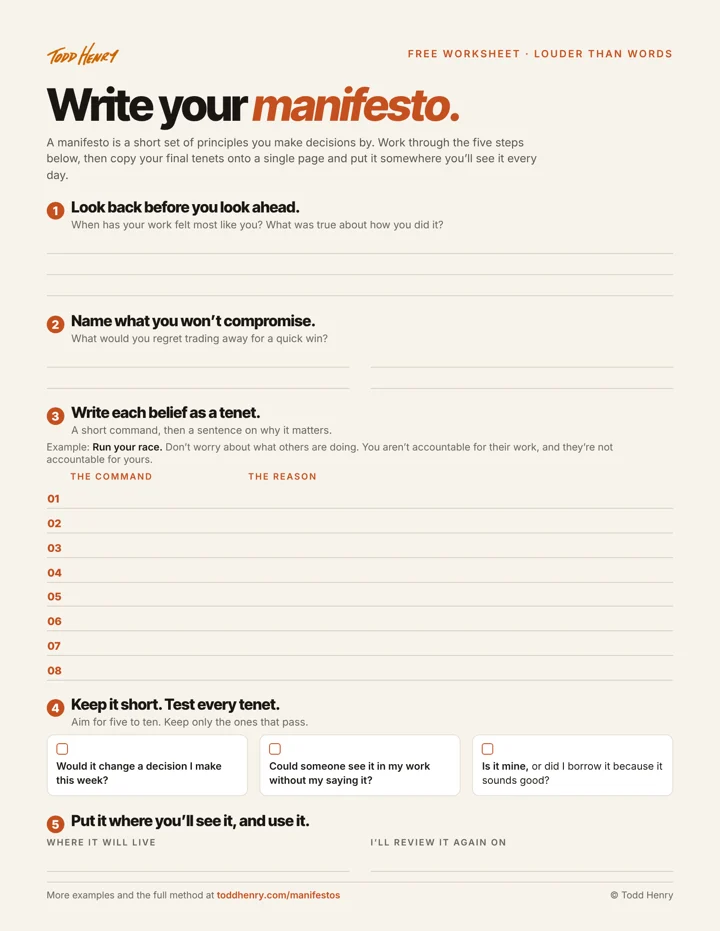
Preview of the one-page Write Your Manifesto worksheet

Free worksheet

Write your manifesto on one page.

A printable worksheet that walks you through the five steps above, with room to draft, test, and finalize your tenets.

  • Prompts to uncover what you believe
  • A simple structure for every tenet
  • A three-question test to keep only what matters

You’ll also get my weekly Action Guide. No spam. Unsubscribe anytime.

Louder Than Words by Todd Henry

From the book

Your manifesto is the start of your voice.

The manifesto is one piece of Louder Than Words, my book about developing an authentic voice and a body of work that resonates. It walks through all three drivers of the Voice Engine, the hurdles that keep people from finding their voice, and how leaders can help a whole team find theirs.

FAQ

Questions about manifestos.

What is a personal manifesto?

A personal manifesto is a short, written set of principles that says what you stand for and how you intend to do your work. It isn’t a detailed plan. It’s a simple set of rules you can use to make decisions, stay true to your values, and show others what matters to you.

How long should a manifesto be?

Short enough to fit on one page and to remember. Most strong personal manifestos have between five and ten tenets, each a short command followed by a sentence of explanation. Mine has nine.

What’s the difference between a manifesto and a mission statement?

A mission statement describes what you or your organization does and for whom. A manifesto describes what you believe and how you’ll behave. A good manifesto is specific enough to change your decisions, not just inspiring enough to hang on a wall.

How do I write a manifesto as a student?

Start with how you want to learn, not what grade you want. Think about the classes and projects where you did your best work, write down what was true about how you approached them, and turn each one into a short command with a reason, like “Show up. Most of what you learn happens because you were in the room.” The student manifesto above and Corita Kent’s rules are good places to start.

Can a team have a manifesto?

Yes, and it can be one of the most useful things a team writes together. Write it as “we” statements about how you’ll work, disagree, decide, and celebrate. In Louder Than Words, I devote a chapter to how leaders can help a team develop its own voice.

How often should I revise my manifesto?

Treat it as a work in progress. Review it regularly, and revisit it whenever your work changes in a meaningful way. If a tenet no longer changes how you act, rewrite it or let it go.