I almost died when I was fifteen years old. During a varsity basketball game I felt a tightness in my back, and that night I woke up unable to move my legs. I crawled arm over arm into the hallway and screamed for my parents. At the hospital, an X-ray revealed a mass the size of a grapefruit in my abdomen. It turned out to be a muscle so swollen with infection that it was pressing major nerves against my spine. For days, friends and family cycled through my room choosing their words carefully, and I didn’t realize until much later that many of them believed they were saying goodbye.
The antibiotics worked. I left the hospital fifty pounds lighter, and for a while taking two steps was a full hour’s work. But I left as a different person. Before my illness I was shy and self-conscious, and I avoided anything I might fail at. Afterward I understood that any failure paled in comparison to what I had just been through. I had experienced the urgency and imminence of the now, and it has shaped my life ever since.
I wrote The Brave Habit hoping to give readers that same perspective without the need for a near-death experience. What follows is a walk through the core ideas of the book, and the simple weekly practice that can help you turn bravery from a difficult decision into an instinct.
The coward withinCowardice usually comes disguised as wisdom.
Inside of you lives a coward. It is obsessed with self-preservation, avoiding risk, protecting your reputation, and avoiding failure. But inside of you also lives the capacity for remarkable bravery. No one aspires to cowardice, yet many of us choose it every day, and we rarely call it by its name. We tell ourselves the idea isn’t ready for the meeting yet, that someone else is better equipped for the project, or that the difficult conversation will only make things worse. Each rationale sounds wise. Many of them are simply excuses.
Your moment is coming. It will be a time of testing, and how you respond could be an inflection point in your life. But your moment probably won’t be a dramatic, public decision. It’s far more likely to be a small, private test: a conversation you need to have, an idea you could share, a project sitting in a drawer that you keep telling yourself isn’t quite ready. Those moments may seem insignificant, but they change the trajectory of your character.
Bravery is doing the right thing, as best you know it, even when it’s the uncomfortable thing.
Bravery is not a personality trait. It’s a decision, and like any difficult discipline it can be developed like a muscle. In my early twenties I was terrified to speak in public. I was so afraid of getting it wrong that I couldn’t think clearly enough to get it right. After years of practice and plenty of failure, my perception of the risk changed completely. What once required enormous bravery now feels natural, which means I have to keep finding new places to practice. Your definition of brave will shift as you grow, too. Bravery is always empathetic, because it’s about something beyond yourself. It is not stupid risk, it is not bravado, and it is never anonymous. It’s action in spite of fear, and the willingness to fail in pursuit of what matters.
The conditionsVision and agency make bravery possible.
Bravery only exists where there is uncertainty. If outcomes were guaranteed, there would be no need for it. Since we can’t wait for certainty before we act, we have to cultivate clarity instead, and two kinds of clarity matter most. Bravery exists when we have a vision for a better possible future, and we trust that we have the agency to help bring it about. When either of those is missing, cowardice becomes very tempting.
The Brave Matrix
Two conditions, four very different outcomes.
Picture optimistic vision running left to right, and perceived agency running bottom to top.
- Futility · high agency, pessimistic visionYou could act, but you don’t believe it would change anything, so why bother?
- Resignation · low agency, pessimistic visionNo hope for a better future and no power to pursue one. You drift with the current.
- Victimhood · low agency, optimistic visionYou can see a better future, but you feel powerless to help bring it about.
- Bravery · high agency, optimistic visionYou can see a better future and believe you can help create it. Brave action becomes possible.
Notice that the bravery quadrant doesn’t guarantee brave action. It simply creates fertile ground for it. The good news is that both conditions can be cultivated. You build agency through three things: proficiency, the skills you trust yourself to use under pressure; people, the relationships you can call on for wisdom and support; and platform, the resources and reach to bring your ideas into the world. You build optimistic vision through what I call productive passion. Passion isn’t just what you enjoy. It’s what you care about so deeply that you’re willing to suffer for it, and that kind of passion is clean fuel for brave action.
Three modesSometimes the brave choice is not to leap.
Most advice about courage boils down to “Just do it, now, before you talk yourself out of it.” It’s well intended, but often unwise. Bravery isn’t only about what you do. Sometimes it’s about what you choose not to do. Brave choices tend to take one of three forms.
The three modes of bravery
Act, let go, or wait.
Each one costs something. Each one can be the right choice at the right moment.
Bravery to act
The most obvious form. Doing the right thing in a moment that matters, even at personal cost, and even when no one would notice if you didn’t.
Bravery to let go
Releasing the way things have been so you can grab hold of what could be, even when the old way is comfortable and familiar.
Bravery to wait
Standing firm when everyone around you is rushing ahead, because the timing isn’t right yet, and acting now would be reckless rather than brave.
Letting go is often the hardest of the three. When I was five, I tried to win the attention of a girl named Jenny by hanging upside down from the monkey bars and shouting her name, without realizing that the recess bell had rung and the entire school was lined up silently watching. Worse, I had a plan for getting up but no plan for getting down, and I hung there until my teacher lifted me off. Child development experts use the word brachiation to describe the ability to let go of one bar while reaching for the next. Most adults have mastered it physically. Psychologically, many of us are still stuck in the middle of the monkey bars, unwilling to release what is comfortable for the sake of what could be.
Your moment
Think of one uncertain situation you’re facing.
A conversation, a decision, an idea, or a change. What kind of bravery does it actually require?
Choose one. Naming it is the first step toward doing it.
The habitFortune favors those who prepare to be brave.
The choreographer Twyla Tharp describes how her morning workout begins long before she reaches the gym. Her ritual isn’t the stretching or the weights. It’s hailing the cab. Once she tells the driver where to go, the rest follows. Bravery works the same way. If you want to act bravely in the big moments, you need a simple ritual that prepares you for them. Fortune favors the brave, as the old proverb says, but I’d put it this way: fortune favors those who prepare themselves for brave action.
The ritual takes about fifteen minutes a week, and its five steps spell a word you won’t forget.
The weekly brave habit
Fifteen minutes, five steps.
Check each one off as you work through it.
One of the most useful tools in that weekly review is the brave question. A brave question is one that you don’t necessarily want the answer to. It might reveal an uncomfortable truth, or create accountability to act in ways you’d rather not. In my experience, people are defined by the quality and courage of their questions, and those willing to ask brave ones get to the truth faster.
Brave togetherBravery is contagious.
You are a person of consequence. Nothing you do happens in isolation, and your choices ripple outward to people you will never meet. That’s especially true if you lead others. Your team takes its cues from you. When you consistently shrink from the moment, they learn that bravery is optional. When you consistently rise to it, they learn that bravery is the norm. You convict others when you act on your own convictions.
Brave work looks like owning your words and actions, sharing your ideas even when they may not be received, and refusing to compromise your values even when it costs you something. Brave teams engage in healthy conflict, protect one another, and give and receive honest feedback, because no one wins when the truth is hidden in order to be liked. Brave leaders have the uncomfortable conversation, speak truth to power, and put their resources where their mouth is. And brave neighbors build real relationships with people who don’t look or think like them, protect one another, and do the unseen things that make a community stronger.
One dayNow is all you have.
In 1959, a teacher named Anthony Burgess was diagnosed with a brain tumor and told he had about a year to live. Wanting to leave his wife something to live on, he wrote furiously, completing five novels in a single year. The diagnosis turned out to be wrong, and he went on to write many more books, including A Clockwork Orange. It’s amazing what we can accomplish when we believe we’re running out of time. The irony is that we are.
Try this. Take out a piece of paper and write the date one year from today at the top. Spend ten minutes considering what you’d like to be different by then. Cross out anything outside your control. Then, for each item that remains, write one small step you can take this week, so small it almost feels easy. When you take it, write the next one.
Decades after that hospital room, I still carry the lesson it taught me. One is the number of days you are given, and today is that day. You will get things wrong, and that’s a certainty. But being wrong isn’t what separates brilliant contributors from everyone else. It’s their willingness to adjust and keep moving forward. Don’t fear wrong action. Fear inaction. One small step in the face of fear is enough to break its hold on you.
Your moment is coming. Decide today who you’ll be when it arrives.
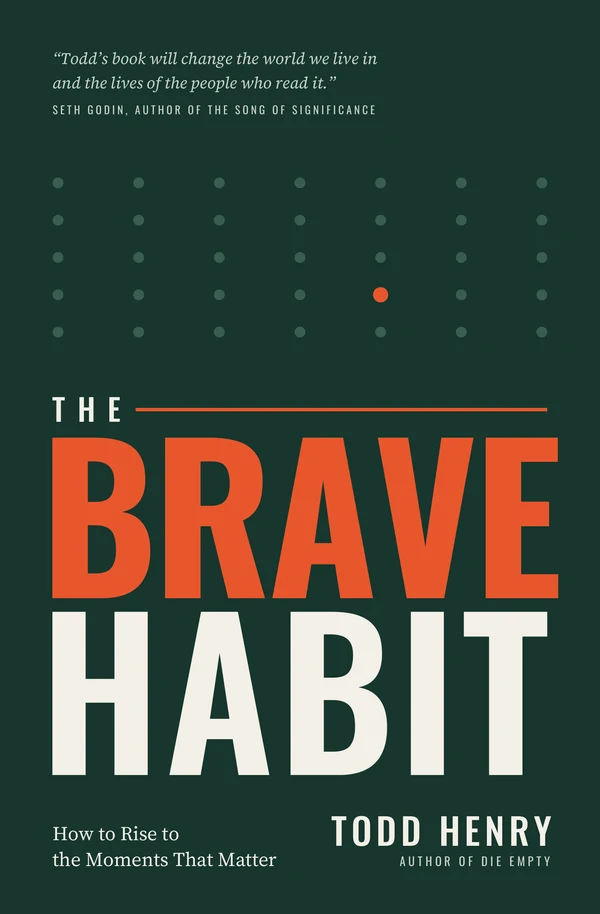
Go deeper with The Brave Habit. Every idea here is unpacked in the book, with exercises for building agency, cultivating optimistic vision, and leading braver teams. Take the free Brave Index or explore the book.
Bring these ideas to your team. The Brave Habit is also a keynote that helps teams turn brave action into an everyday norm.
Explore the keynote
Todd Henry
Todd teaches leaders and teams how to be brave, focused, and brilliant. He’s the author of seven books, including Herding Tigers and The Brave Habit, and host of the Daily Creative podcast.